Justice
Justice weighs truth impartially, calling for fairness, accountability, and clear decisions whose consequences follow from our actions.
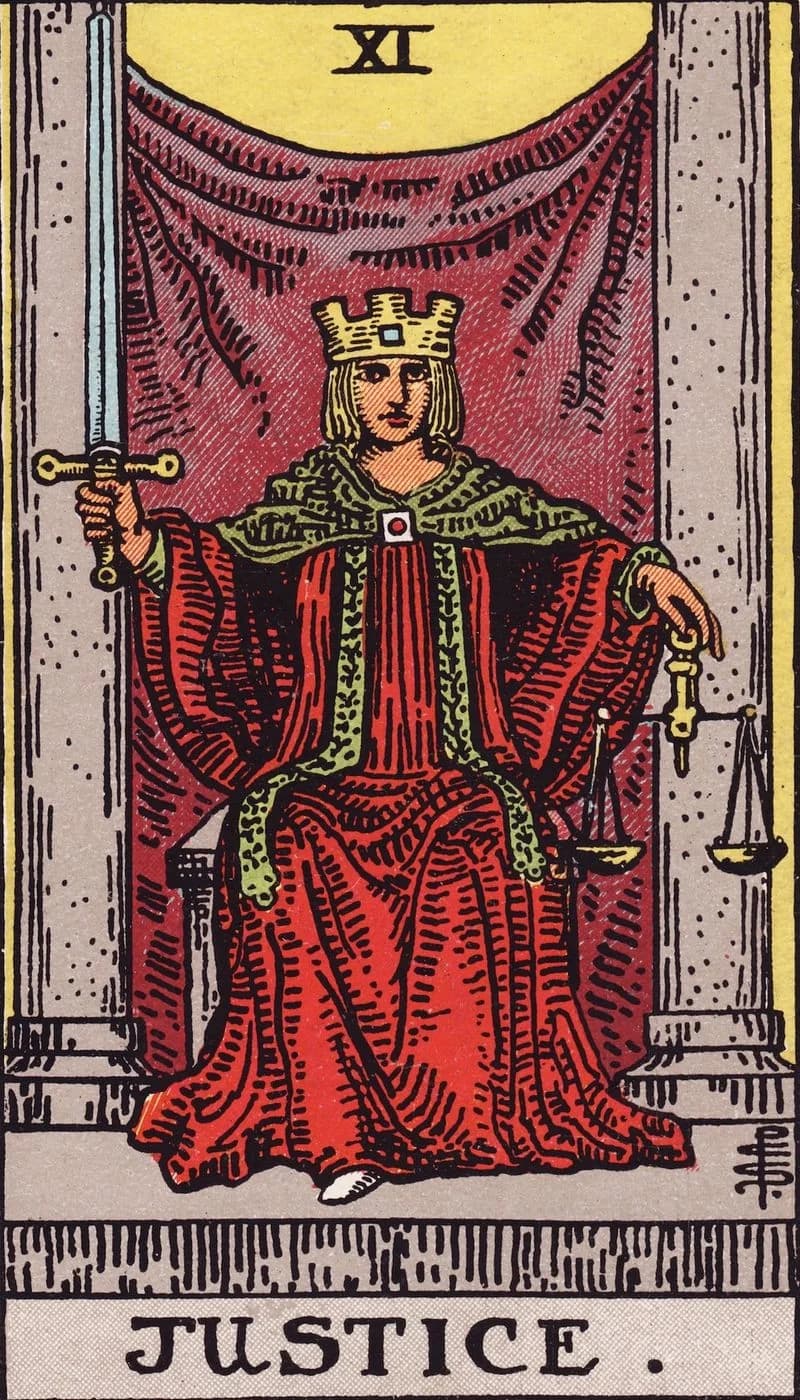
Major Arcana XI
Upright keywords
- fairness
- truth
- accountability
- cause and effect
- balance
- legal matters
Meaning when upright
Justice sits between two pillars holding an upright sword and balanced scales, the image of impartial judgment. The card asks you to weigh the facts honestly, take responsibility for your part, and act with integrity, knowing that consequences follow choices. In practical terms it often concerns contracts, legal matters, or decisions that will be judged on their merits; Waite speaks of equity, probity, and the triumph of the deserving side in law. Where you have acted fairly, it promises a fair result.
On the card
- upright double-edged sword in her right hand
- Clear, decisive judgment that cuts both ways; truth and its consequences.
- balanced scales in her left hand
- Impartial weighing of evidence, fairness, and equilibrium.
- seated between two gray pillars
- Like the High Priestess she sits between pillars, but Waite notes that the pillars of Justice open into a different world: the moral law.
- purple veil hanging behind her
- What lies beyond human judgment; the mysterious spiritual order Waite distinguishes from moral justice.
- crown set with a square jewel
- Ordered, clear reasoning and the authority of law.
- red robe and green mantle
- Decisive action balanced by compassion and care.
- white shoe showing beneath her robe
- The judgment stepping out into the world: actions and their consequences.
- yellow sky above the veil
- Illumination and intellectual clarity.
In Waite’s words
As this card follows the traditional symbolism and carries above all its obvious meanings, there is little to say regarding it outside the few considerations collected in the first part, to which the reader is referred.
It will be seen, however, that the figure is seated between pillars, like the High Priestess, and on this account it seems desirable to indicate that the moral principle which deals unto every man according to his works—while, of course, it is in strict analogy with higher things—differs in its essence from the spiritual justice which is involved in the idea of election. The latter belongs to a mysterious order of Providence, in virtue of which it is possible for certain men to conceive the idea of dedication to the highest things. The operation of this is like the breathing of the Spirit where it wills, and we have no canon of criticism or ground of explanation concerning it. It is analogous to the possession of the fairy gifts and the high gifts and the gracious gifts of the poet: we have them or have not, and their presence is as much a mystery as their absence. The law of Justice is not however involved by either alternative. In conclusion, the pillars of Justice open into one world and the pillars of the High Priestess into another.
- Divinatory meaning
Equity, rightness, probity, executive; triumph of the deserving side in law.
- Reversed
Law in all its departments, legal complications, bigotry, bias, excessive severity.
Correspondences
- Element
- Air
- Astrology
- Libra
- Hebrew letter
- Lamed (ל)
- Path on the Tree of Life
- Path 22: Geburah – Tiphareth
- Number
- Eleven (1 + 1 = 2) repeats the High Priestess's theme of balance between pillars, now applied to cause, effect, and moral choice.
To reflect on
- What truth am I avoiding in this situation?
- Where do I need to take responsibility for my part?
- Am I judging others, or myself, more harshly than is fair?
In your readings
Hasn’t appeared in your readings yet.
Ask about this card
Marguerite, the traditionalist, answers from Waite’s text, what is drawn on the card and its correspondences. You can choose another reader in settings.