The Hanged Man
The Hanged Man is willing suspension: surrendering control, pausing the action, and seeing the world from a new angle so that insight can arrive.
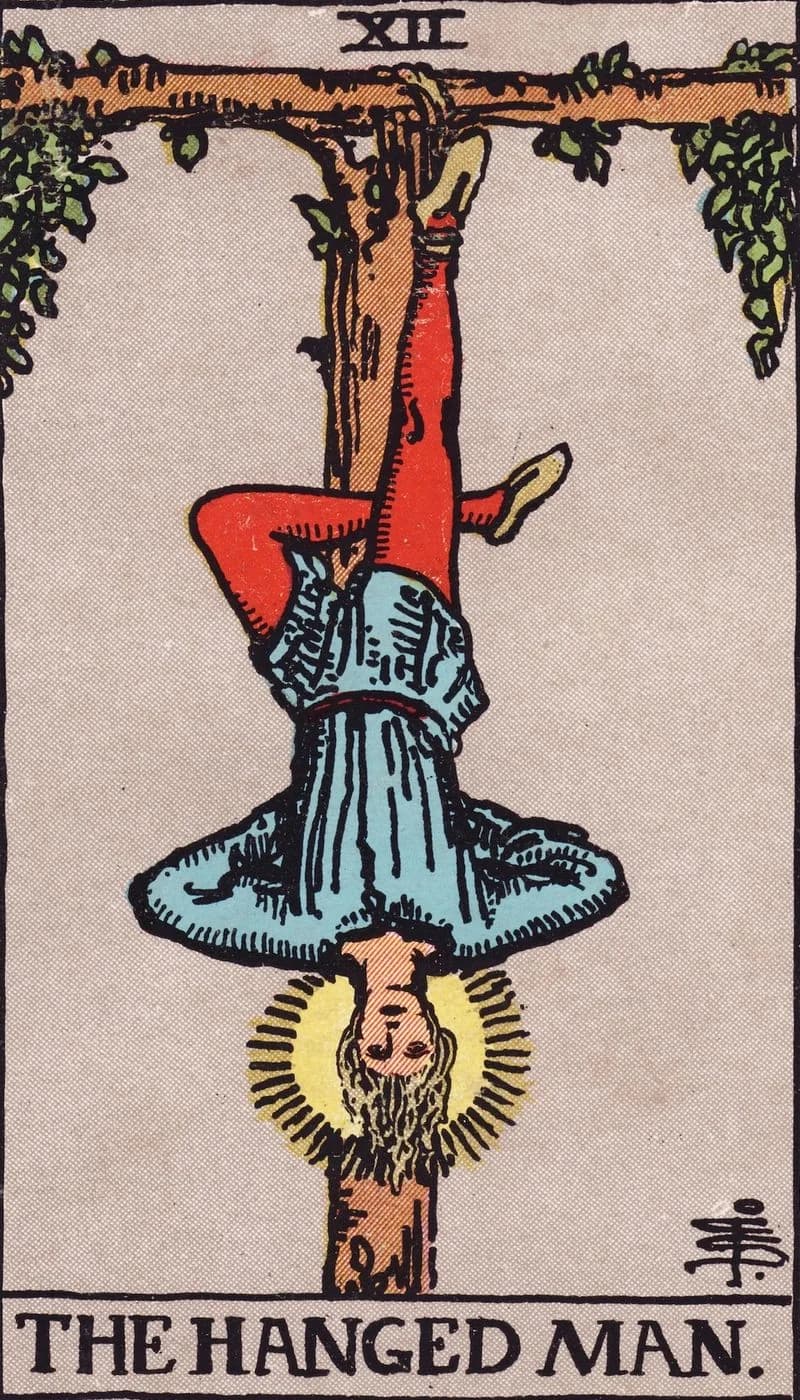
Major Arcana XII
Upright keywords
- surrender
- pause
- new perspective
- letting go
- sacrifice
- suspension
Meaning when upright
The Hanged Man hangs calmly upside down from a living tree, a halo around his head, suffering nothing but a change of viewpoint. The card calls for a pause: stop pushing, let go of the need to control the outcome, and allow a new perspective to emerge. Sacrifice may be involved, but it is the kind that leads to deeper understanding, and Waite links the card to wisdom, discernment, intuition, and prophecy. What looks like delay may be a necessary period of gestation.
On the card
- man hanging upside down by one foot
- Willing suspension and the reversal of ordinary perspective; Waite says the figure suggests life in suspension, but life and not death.
- T-shaped gallows of living wood with leaves
- Waite's Tau cross and tree of sacrifice, which he stresses is living wood: sacrifice that bears life.
- radiant halo around his head
- Waite's nimbus: enlightenment and the insight that comes through surrender.
- calm, serene face
- Waite notes the face expresses deep entrancement, not suffering.
- free leg bent behind the other
- The legs form a cross, Waite's fylfot, a posture echoed by the dancer of the World.
- arms folded behind his back
- Action deliberately set aside; passivity by choice.
- red hose and blue tunic
- Passion and physical life joined with calm and spirit, opposites held in stillness.
In Waite’s words
The gallows from which he is suspended forms a Tau cross, while the figure—from the position of the legs—forms a fylfot cross. There is a nimbus about the head of the seeming martyr. It should be noted (1) that the tree of sacrifice is living wood, with leaves thereon; (2) that the face expresses deep entrancement, not suffering; (3) that the figure, as a whole, suggests life in suspension, but life and not death. It is a card of profound significance, but all the significance is veiled. One of his editors suggests that Éliphas Lévi did not know the meaning, which is unquestionable—nor did the editor himself. It has been called falsely a card of martyrdom, a card of prudence, a card of the Great Work, a card of duty; but we may exhaust all published interpretations and find only vanity. I will say very simply on my own part that it expresses the relation, in one of its aspects, between the Divine and the Universe.
He who can understand that the story of his higher nature is imbedded in this symbolism will receive intimations concerning a great awakening that is possible, and will know that after the sacred Mystery of Death there is a glorious Mystery of Resurrection.
- Divinatory meaning
Wisdom, circumspection, discernment, trials, sacrifice, intuition, divination, prophecy.
- Reversed
Selfishness, the crowd, body politic.
Correspondences
- Element
- Water
- Astrology
- Water (element)
- Hebrew letter
- Mem (מ)
- Path on the Tree of Life
- Path 23: Geburah – Hod
- Number
- Twelve (1 + 2 = 3) turns the Empress's creativity inside out: growth now comes through gestation, surrender, and a reversed point of view.
To reflect on
- What am I trying to control that I could release?
- What would this situation look like from the opposite point of view?
- Is my waiting purposeful, or am I stuck?
In your readings
Hasn’t appeared in your readings yet.
Ask about this card
Marguerite, the traditionalist, answers from Waite’s text, what is drawn on the card and its correspondences. You can choose another reader in settings.