Wheel of Fortune
The Wheel of Fortune turns through cycles of rise and fall, reminding us that change is constant and that destiny moves in patterns we can learn to ride.
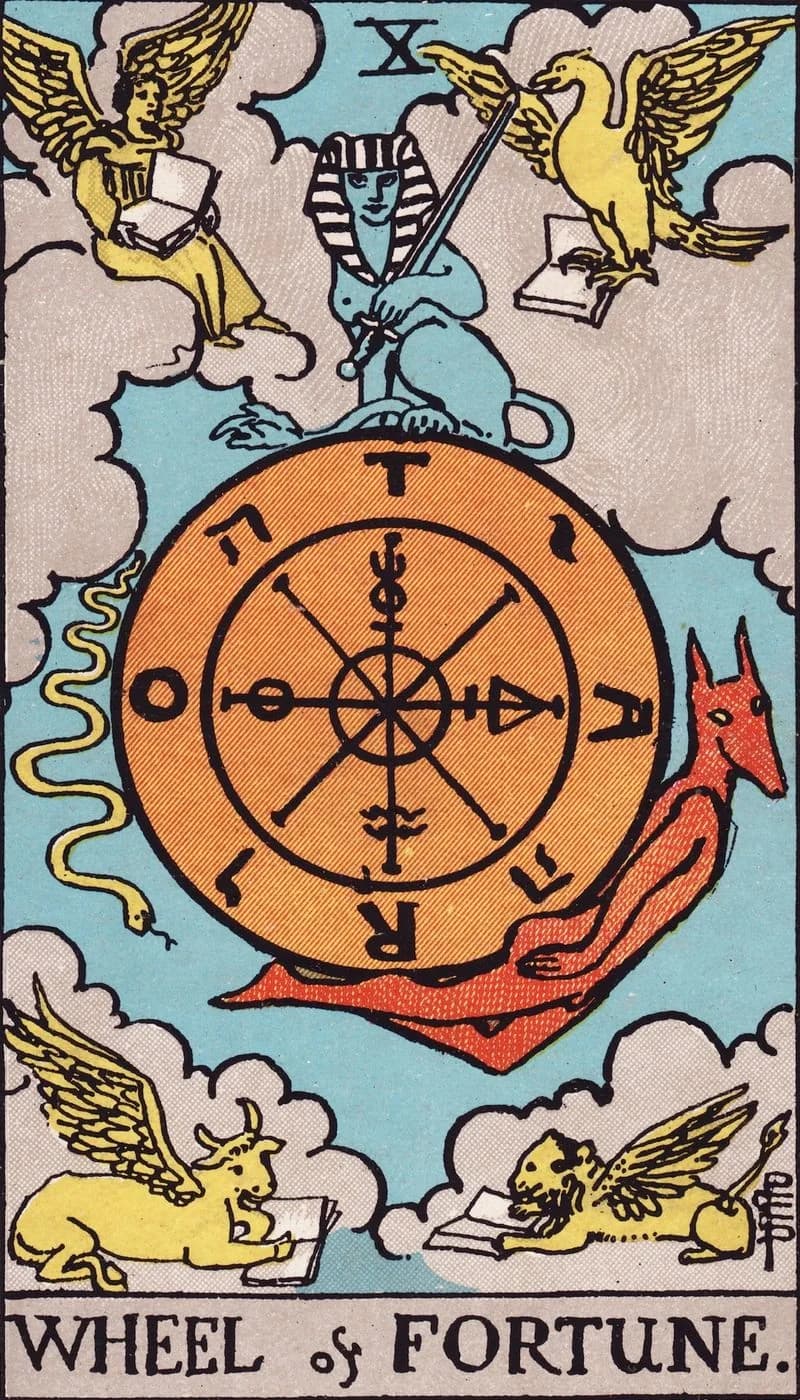
Major Arcana X
Upright keywords
- cycles
- change
- destiny
- turning point
- luck
- opportunity
Meaning when upright
The Wheel of Fortune marks a turning point: circumstances shift, a new cycle begins, and events may move faster than planned. Waite gives it destiny, fortune, success, elevation, luck, and felicity, but its deeper teaching is that nothing stays at the top or the bottom forever. The sphinx sitting calmly at the summit suggests that equilibrium is possible in the midst of movement. Welcome the change and look for the opportunity it brings.
On the card
- great wheel inscribed with the letters T, A, R, O and Hebrew letters
- Waite's transliteration of Taro as Rota (wheel), counterchanged with the letters of the Divine Name to show that Providence is implied through all.
- sphinx holding a sword at the top of the wheel
- Equilibrium and wisdom; Waite calls the Sphinx the equilibrium within the turning.
- yellow serpent descending on the left
- Typhon in his serpent form: the descent into matter and the downward swing of fortune.
- red jackal-headed figure rising on the right
- Hermanubis, the rising intelligence carried upward as the wheel turns.
- four winged creatures reading books in the corners
- The four Living Creatures of Ezekiel (angel, eagle, bull, lion), linked to the fixed signs; steady wisdom amid change.
- alchemical symbols on the inner spokes
- Mercury, sulfur, salt, and water: the elements of transformation at the wheel's hub.
- wheel floating among clouds in a blue sky
- The higher plane from which the turning of fate is ordered.
In Waite’s words
In this symbol I have again followed the reconstruction of Éliphas Lévi, who has furnished several variants. It is legitimate—as I have intimated—to use Egyptian symbolism when this serves our purpose, provided that no theory of origin is implied therein. I have, however, presented Typhon in his serpent form. The symbolism is, of course, not exclusively Egyptian, as the four Living Creatures of Ezekiel occupy the angles of the card, and the wheel itself follows other indications of Lévi in respect of Ezekiel's vision, as illustrative of the particular Tarot Key. With the French occultist, and in the design itself, the symbolic picture stands for the perpetual motion of a fluidic universe and for the flux of human life. The Sphinx is the equilibrium therein. The transliteration of Taro as Rota is inscribed on the wheel, counterchanged with the letters of the Divine Name—to shew that Providence is implied through all. But this is the Divine intention within, and the similar intention without is exemplified by the four Living Creatures. Sometimes the sphinx is represented couchant on a pedestal above, which defrauds the symbolism by stultifying the essential idea of stability amidst movement.
Behind the general notion expressed in the symbol there lies the denial of chance and the fatality which is implied therein. It may be added that, from the days of Lévi onward, the occult explanations of this card are—even for occultism itself—of a singularly fatuous kind. It has been said to mean principle, fecundity, virile honour, ruling authority, etc. The findings of common fortune-telling are better than this on their own plane.
- Divinatory meaning
Destiny, fortune, success, elevation, luck, felicity.
- Reversed
Increase, abundance, superfluity.
Correspondences
- Element
- Fire
- Astrology
- Jupiter
- Hebrew letter
- Kaph (כ)
- Path on the Tree of Life
- Path 21: Chesed – Netzach
- Number
- Ten is completion and the end of a cycle; the Wheel closes the first decade of the trumps and, as 1 + 0, turns back toward a new beginning.
To reflect on
- What cycle is ending or beginning in my life?
- Which patterns keep repeating, and what is my part in them?
- How can I stay centered while circumstances change?
In your readings
Hasn’t appeared in your readings yet.
Ask about this card
Marguerite, the traditionalist, answers from Waite’s text, what is drawn on the card and its correspondences. You can choose another reader in settings.