The Hierophant
The Hierophant is the keeper of tradition and shared belief, teaching through established institutions, ritual, and wisdom handed down from teacher to student.
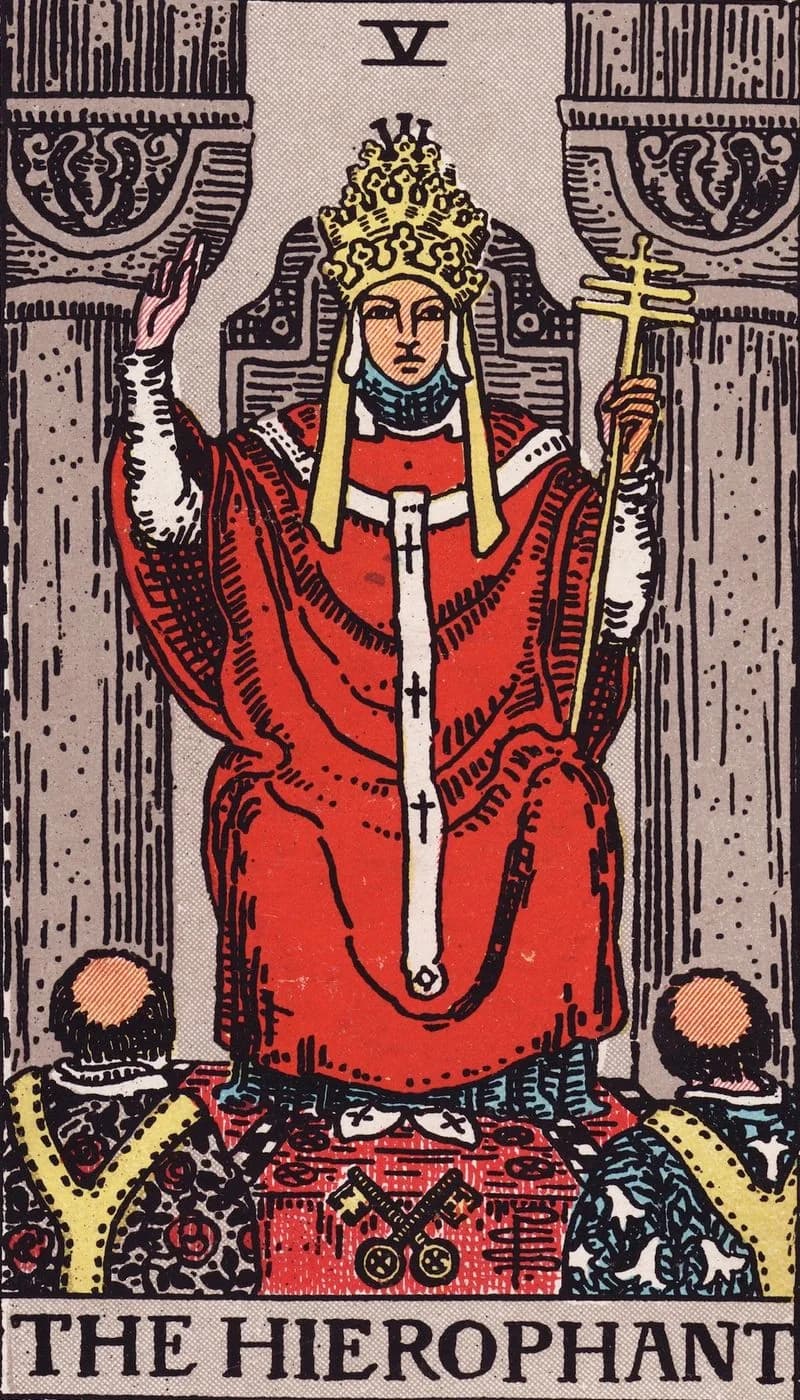
Major Arcana V
Upright keywords
- tradition
- spiritual guidance
- institutions
- conformity
- teaching
- shared values
Meaning when upright
The Hierophant represents the structures through which wisdom is transmitted: religions, schools, professions, rituals, and the teachers who guard them. He counsels learning from established methods, seeking a mentor, or working within a recognized system. In a reading he may point to a formal commitment such as a ceremony or marriage, which Waite lists first among his meanings. His blessing offers the comfort of belonging to a community with shared values.
On the card
- triple crown
- Authority over the three worlds, often read as the physical, mental, and spiritual planes.
- right hand raised in blessing
- The ecclesiastical sign Waite describes, distinguishing between the manifest and concealed parts of doctrine.
- triple-cross scepter in his left hand
- Religious authority reaching through the three worlds.
- crossed keys at his feet
- The power of the keys: exoteric doctrine and the authority to bind and loose, open and close.
- two tonsured ministers kneeling before him, their robes patterned with roses and lilies
- Disciples receiving teaching; the roses and lilies echo the Magician's garden of desire and purity.
- two gray pillars
- The pillars of an outer, exoteric temple, which Waite stresses are not those of the High Priestess's temple.
- red robe with a white stole marked with crosses
- Active worldly authority joined to sacred office.
In Waite’s words
He wears the triple crown and is seated between two pillars, but they are not those of the Temple which is guarded by the High Priestess. In his left hand he holds a sceptre terminating in the triple cross, and with his right hand he gives the well-known ecclesiastical sign which is called that of esotericism, distinguishing between the manifest and concealed part of doctrine. It is noticeable in this connexion that the High Priestess makes no sign. At his feet are the crossed keys, and two priestly ministers in albs kneel before him. He has been usually called the Pope, which is a particular application of the more general office that he symbolizes. He is the ruling power of external religion, as the High Priestess is the prevailing genius of the esoteric, withdrawn power. The proper meanings of this card have suffered woeful admixture from nearly all hands. Grand Orient says truly that the Hierophant is the power of the keys, exoteric orthodox doctrine, and the outer side of the life which leads to the doctrine; but he is certainly not the prince of occult doctrine, as another commentator has suggested.
He is rather the summa totius theologiæ, when it has passed into the utmost rigidity of expression; but he symbolizes also all things that are righteous and sacred on the manifest side. As such, he is the channel of grace belonging to the world of institution as distinct from that of Nature, and he is the leader of salvation for the human race at large. He is the order and the head of the recognized hierarchy, which is the reflection of another and greater hierarchic order; but it may so happen that the pontiff forgets the significance of this his symbolic state and acts as if he contained within his proper measures all that his sign signifies or his symbol seeks to shew forth. He is not, as it has been thought, philosophy—except on the theological side; he is not inspiration; and he is not religion, although he is a mode of its expression.
- Divinatory meaning
Marriage, alliance, captivity, servitude; by another account, mercy and goodness; inspiration; the man to whom the Querent has recourse.
- Reversed
Society, good understanding, concord, over-kindness, weakness.
Correspondences
- Element
- Earth
- Astrology
- Taurus
- Hebrew letter
- Vav (ו)
- Path on the Tree of Life
- Path 16: Chokmah – Chesed
- Number
- Five brings movement beyond the stable four; the Hierophant introduces the question of meaning and belief, mediating between the human and the sacred.
To reflect on
- Which traditions or teachers have shaped what I believe?
- What rules do I follow without questioning them?
- Where would guidance or mentorship help me now?
In your readings
Hasn’t appeared in your readings yet.
Ask about this card
Marguerite, the traditionalist, answers from Waite’s text, what is drawn on the card and its correspondences. You can choose another reader in settings.