The Emperor
The Emperor is order, authority, and structure: the fatherly principle that establishes boundaries and rules so that life can be governed and protected.
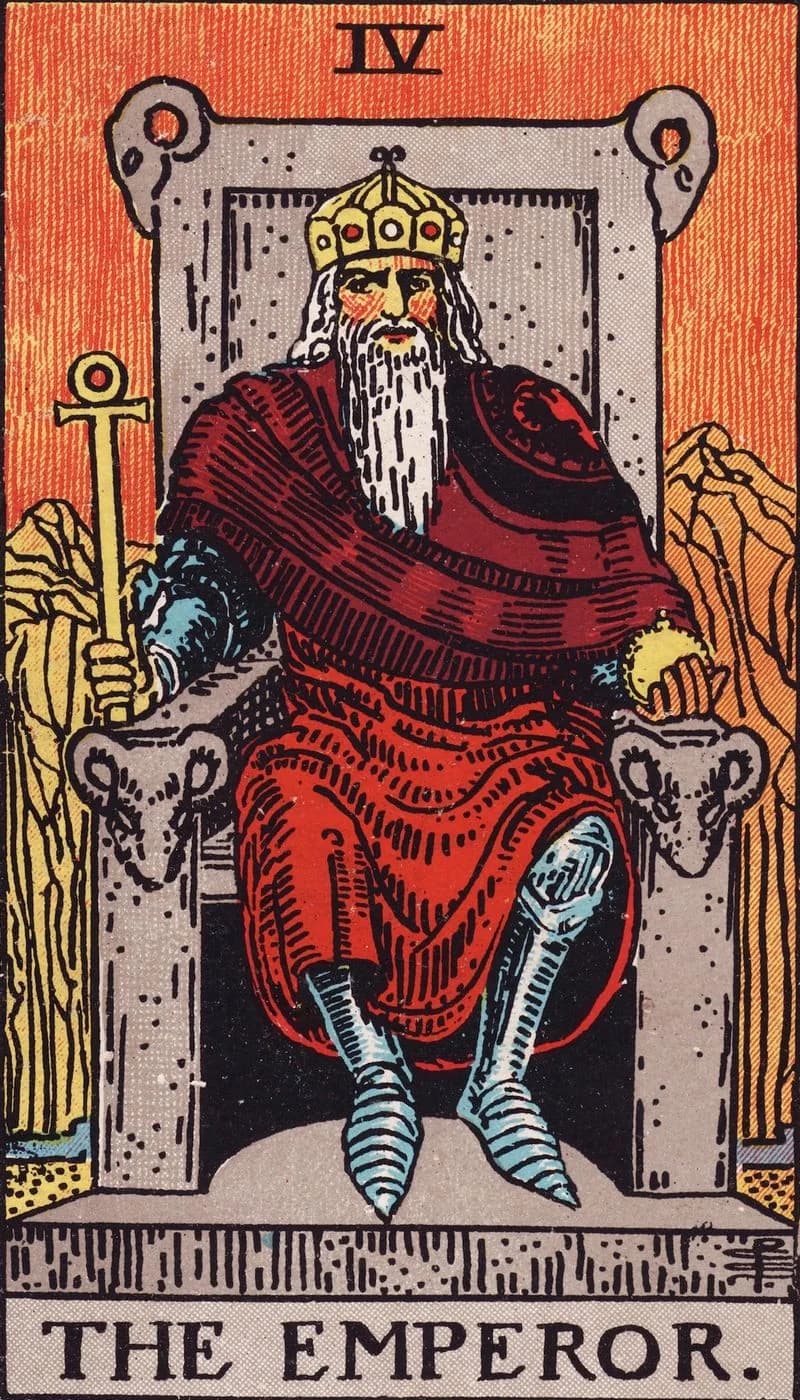
Major Arcana IV
Upright keywords
- authority
- structure
- stability
- leadership
- protection
- discipline
Meaning when upright
The Emperor brings structure to the Empress's abundance, turning potential into an organized and defensible order. He stands for leadership, responsibility, planning, and the capacity to set clear rules and keep them. In a reading he may represent an authority figure, a father, an institution, or your own ability to take charge and build something that lasts. His stone throne and armor suggest stability won through discipline and experience.
On the card
- stone throne carved with rams' heads
- Aries, the Emperor's sign, and its forceful Martian energy; stone speaks of permanence.
- ankh-shaped scepter in his right hand
- Waite's form of the crux ansata: life and dominion held in the ruler's grasp.
- golden orb in his left hand
- Rule over the world and the material realm.
- armor visible beneath his red robe
- Readiness to defend what he has built; power grounded in discipline.
- long white beard
- Age, experience, and the wisdom of long rule.
- barren, rugged mountains behind the throne
- Hard-won achievement and the austere heights of authority, but also inflexibility.
- crown on his head
- Sovereignty and worldly rule; Waite's crowned monarch, commanding and stately.
- red-orange sky and robe
- Fire, vitality, and the will to command.
In Waite’s words
He has a form of the Crux ansata for his sceptre and a globe in his left hand. He is a crowned monarch—commanding, stately, seated on a throne, the arms of which are fronted by rams' heads. He is executive and realization, the power of this world, here clothed with the highest of its natural attributes. He is occasionally represented as seated on a cubic stone, which, however, confuses some of the issues. He is the virile power, to which the Empress responds, and in this sense is he who seeks to remove the Veil of Isis; yet she remains virgo intacta.
It should be understood that this card and that of the Empress do not precisely represent the condition of married life, though this state is implied. On the surface, as I have indicated, they stand for mundane royalty, uplifted on the seats of the mighty; but above this there is the suggestion of another presence. They signify also—and the male figure especially—the higher kingship, occupying the intellectual throne. Hereof is the lordship of thought rather than of the animal world. Both personalities, after their own manner, are "full of strange experience," but theirs is not consciously the wisdom which draws from a higher world. The Emperor has been described as (a) will in its embodied form, but this is only one of its applications, and (b) as an expression of virtualities contained in the Absolute Being—but this is fantasy.
- Divinatory meaning
Stability, power, protection, realization; a great person; aid, reason, conviction; also authority and will.
- Reversed
Benevolence, compassion, credit; also confusion to enemies, obstruction, immaturity.
Correspondences
- Element
- Fire
- Astrology
- Aries
- Hebrew letter
- Heh (ה)
- Path on the Tree of Life
- Path 15: Chokmah – Tiphareth
- Number
- Four is structure and foundation, the square that makes things stable; the Emperor turns the Empress's growth into lasting order.
To reflect on
- Where do I need clearer structure or boundaries?
- How do I respond to authority, and how do I use my own?
- What am I trying to protect, and is my approach too rigid?
In your readings
Hasn’t appeared in your readings yet.
Ask about this card
Marguerite, the traditionalist, answers from Waite’s text, what is drawn on the card and its correspondences. You can choose another reader in settings.