The Chariot
The Chariot is victory through willpower and self-command, harnessing opposing forces and driving them forward in a single direction.
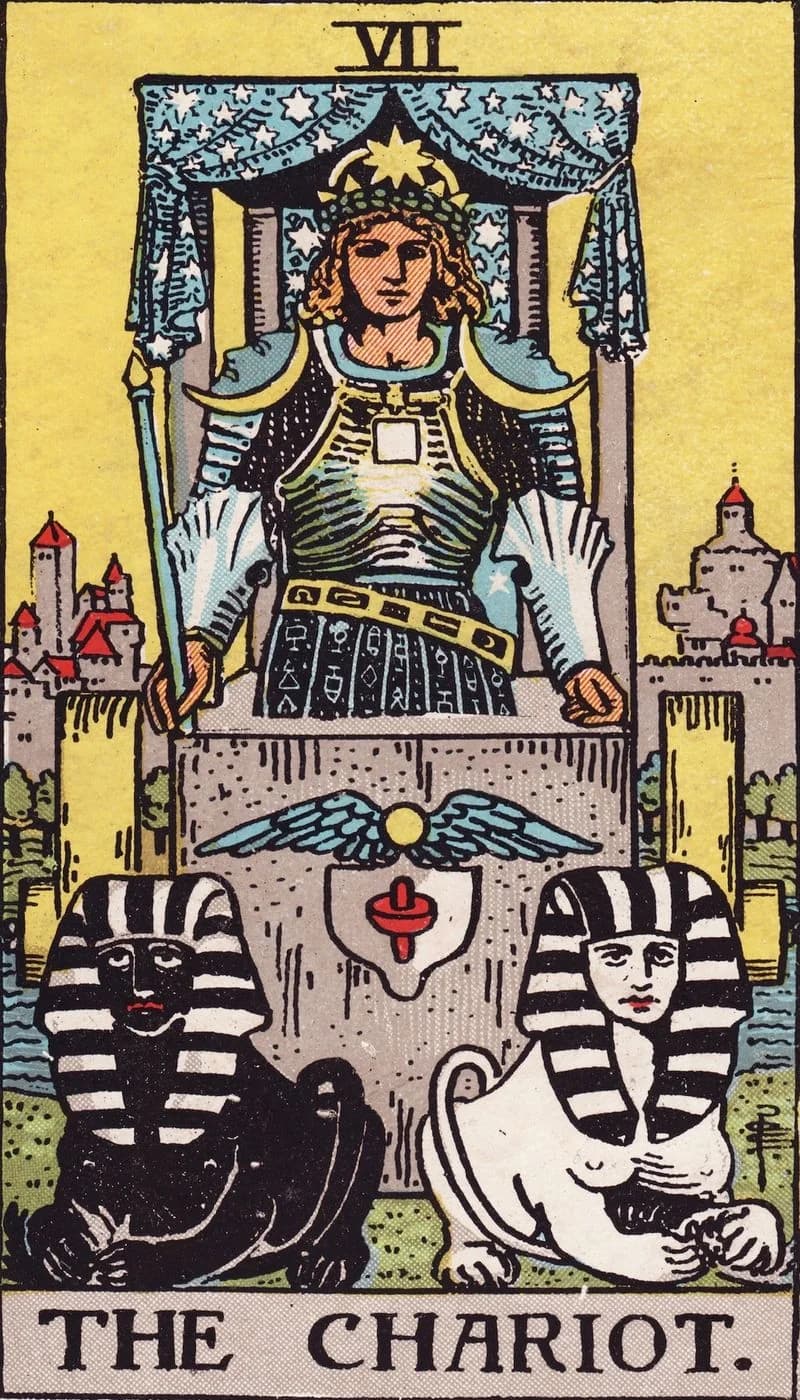
Major Arcana VII
Upright keywords
- determination
- victory
- willpower
- self-control
- momentum
- ambition
Meaning when upright
The Chariot shows a victorious prince who steers without reins, keeping two opposing sphinxes on course by concentrated will. It promises progress and triumph when you commit to a direction and refuse to be pulled apart by conflicting impulses. Discipline, confidence, and focus are the engines here, and obstacles yield to persistence. The card can also refer to travel, a vehicle, or a decisive push toward a goal.
On the card
- black and white sphinxes drawing the chariot
- Opposing forces such as instinct and reason or mercy and severity, held in balance by the driver's will; Waite adopted the sphinxes from Éliphas Lévi.
- charioteer holding a wand-like scepter, with no reins
- Control through focused mind and will rather than physical force; Waite's text mentions a drawn sword, but the card shows a scepter.
- canopy spangled with stars
- Celestial influence and protection; the heavens backing the victor.
- crescent moons on his shoulders
- Waite's Urim and Thummim, and the lunar, emotional forces the rider has mastered.
- square on his breastplate
- Earthly foundation and strength of will; the four elements under control.
- crown bearing a star
- Spiritual attainment and the victor's crown.
- winged sun disk on the front of the chariot
- The Egyptian winged sun: spirit elevating and guiding movement.
- walled city and river behind him
- The settled world he has left behind to advance, and the waters he has crossed.
In Waite’s words
An erect and princely figure carrying a drawn sword and corresponding, broadly speaking, to the traditional description which I have given in the first part. On the shoulders of the victorious hero are supposed to be the Urim and Thummim. He has led captivity captive; he is conquest on all planes—in the mind, in science, in progress, in certain trials of initiation. He has thus replied to the sphinx, and it is on this account that I have accepted the variation of Éliphas Lévi; two sphinxes thus draw his chariot. He is above all things triumph in the mind.
It is to be understood for this reason (a) that the question of the sphinx is concerned with a Mystery of Nature and not of the world of Grace, to which the charioteer could offer no answer; (b) that the planes of his conquest are manifest or external and not within himself; (c) that the liberation which he effects may leave himself in the bondage of the logical understanding; (d) that the tests of initiation through which he has passed in triumph are to be understood physically or rationally; and (e) that if he came to the pillars of that Temple between which the High Priestess is seated, he could not open the scroll called Tora, nor if she questioned him could he answer. He is not hereditary royalty and he is not priesthood.
- Divinatory meaning
Succour, providence; also war, triumph, presumption, vengeance, trouble.
- Reversed
Riot, quarrel, dispute, litigation, defeat.
Correspondences
- Element
- Water
- Astrology
- Cancer
- Hebrew letter
- Cheth (ח)
- Path on the Tree of Life
- Path 18: Binah – Geburah
- Number
- Seven is assessment and the test of will; the Chariot closes the first stage of the Fool's journey with a victory won by self-mastery.
To reflect on
- What direction am I truly committed to?
- Which opposing forces in me need to work together?
- Where am I using force when focus would serve better?
In your readings
Hasn’t appeared in your readings yet.
Ask about this card
Marguerite, the traditionalist, answers from Waite’s text, what is drawn on the card and its correspondences. You can choose another reader in settings.